

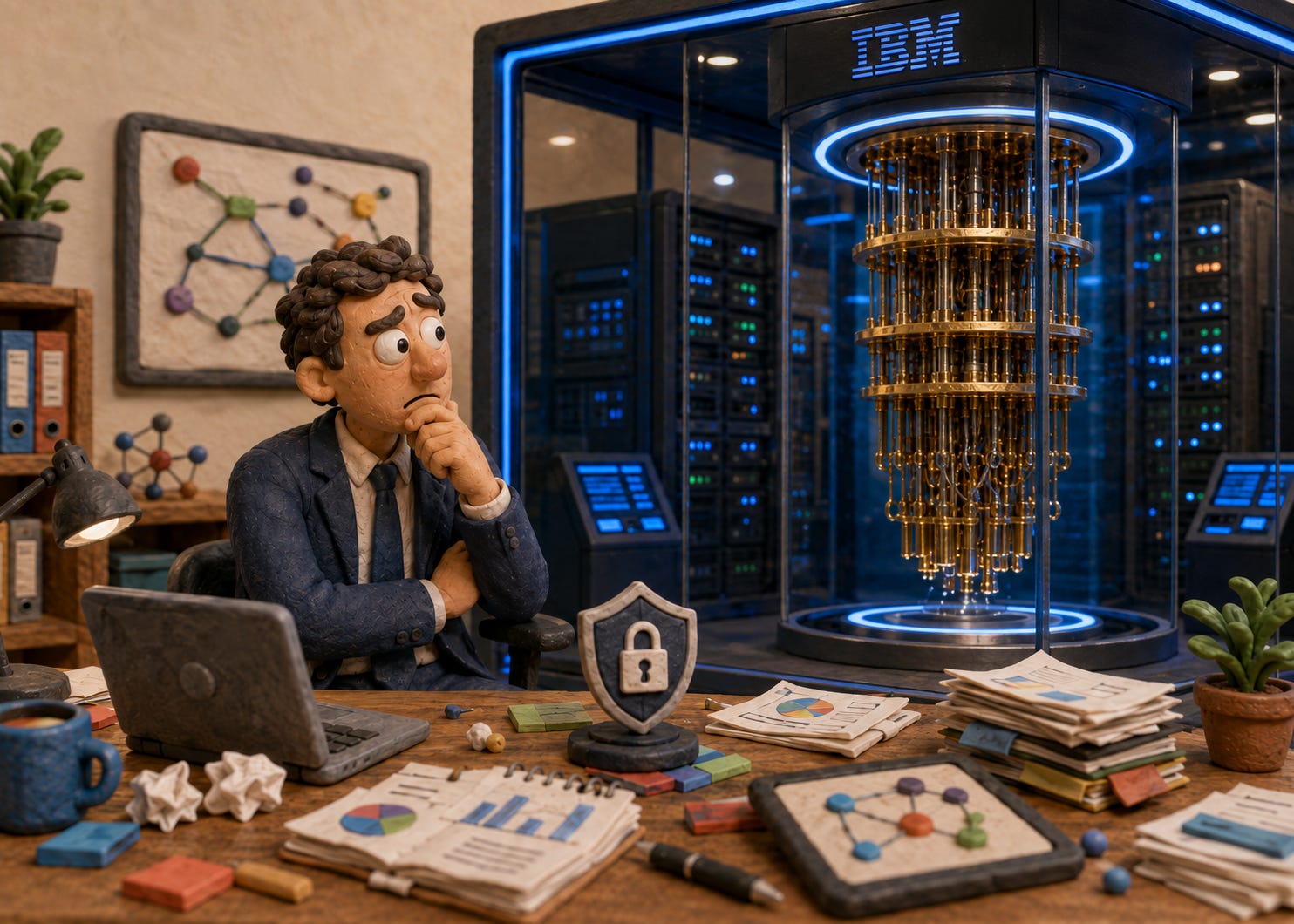
In this edition: IBM announced plans to invest more than $10 billion in quantum computing over five years, advanced Anderon as America’s first proposed purpose-built quantum wafer foundry with a proposed $1 billion CHIPS Act award, signed a definitive agreement to acquire HRL Laboratories, and coordinated three preprints under a declared “quantum advantage era” (the papers support materially different strengths of claim). CEO Arvind Krishna then said quantum could have a measurable impact on IBM’s top and bottom line by 2028 or 2029, sixteen days after the company’s worst stock session on record. I trace the pieces and ask whether IBM is building a computer or an industrial platform. Separately, IonQ demonstrated memory-lifetime breakeven for trapped-ion qLDPC codes, while Atom Computing reported repeated toric-code error correction with atom replacement on neutral atoms. QuEra published a 2028 roadmap targeting more than 256 logical qubits on Amazon Braket, and the Mitten-code team proposed a high-rate qLDPC processor design encoding 195 logical qubits in a 975-qubit code block. An NSF-supported neutral-atom community roadmap places theoretical RSA-2048 resource requirements beside experimental capability on a logarithmic chart. D-Wave formalized a gate-model roadmap alongside its annealing business. In the Quantum Flapdoodle section: SAXON Q’s aggregate multi-core qubit count, EY’s under-specified photonic machine in Toronto, and the quantum-sector SPAC cohort whose published 2025 revenue forecasts totaled $1.185 billion while reported revenue came to approximately $138 million.
IBM’s Ten-Week Quantum Campaign
On May 21, IBM and the US Department of Commerce announced Anderon, a proposed 300-millimeter quantum wafer foundry in Albany, supported by a proposed $1 billion CHIPS Act award matched by $1 billion from IBM in cash, intellectual property, and personnel. Twelve days later, on June 2, IBM announced plans to invest more than $10 billion over five years in quantum computing, spanning R&D, capital expenditure, manufacturing, partnerships, and acquisitions. The Starling roadmap targets IBM’s first fault-tolerant quantum system by 2029, followed by Blue Jay, targeting 2,000 logical qubits. This is one of the largest single-company quantum investments ever disclosed, on the order of everything quantum startups have raised from venture capital combined.
Six weeks later, IBM’s stock fell 25% in a single session after the company warned that customers were redirecting capital spending toward supply-constrained AI infrastructure and that several large transactions had failed to close. July 14 became the worst trading day in IBM’s history.
Nine days after the crash, IBM signed a definitive agreement to acquire HRL Laboratories, the R&D institution jointly owned by Boeing and General Motors. HRL brings silicon spin qubits together with expertise in cryogenics, control electronics, interconnects, packaging, and quantum materials. In a separate demonstration, HRL placed a custom CMOS controller at 4 kelvin and connected it through a superconducting ribbon to millikelvin silicon spin qubits, reducing the room-temperature control and wiring burden that currently limits scaling. The acquisition is expected to close by end of Q3 2026.
Sixteen days after the crash, CEO Arvind Krishna appeared on CNBC’s Mad Money and made two statements worth reading carefully. First: quantum computing will have “a measurable impact” on IBM’s top and bottom line by 2028 or 2029. Second: “By the end of the 2030s, we are now pretty convinced this is a trillion dollars of value.” The timing made the appearance both investor reassurance and long-term positioning. Krishna transformed IBM’s quantum roadmap from a research promise into a dated financial claim, and therefore into something investors can eventually falsify.
The same day, IBM coordinated announcements around three preprints posted on July 27 and 28 and declared the beginning of a “quantum advantage era.” The papers support materially different strengths of claim. The University of Chicago result makes the clearest formal case, combining structured circuits with complexity-theoretic hardness guarantees and a device-dependent fidelity certificate on 70 data qubits (97 physical). Qedma reports 74-qubit many-body dynamics in a regime where the tested tensor-network and Pauli-path methods either failed or became unreliable, despite extensive classical compute including 12,888 Fugaku nodes. Algorithmiq presents a framework for trusting an observable estimate when no accessible classical ground truth exists, describing the quantum answer as the most credible among the methods considered. IBM branded all three as quantum advantage. The papers themselves do not make three equivalent claims. (Earlier in July, IBM’s fusion blanket chemistry result added roughly $9.4 billion to the company’s market capitalization, although the move cannot be attributed to the paper alone: Bank of America raised its price target the same morning on software and cash-flow grounds, and the gain had reversed by Friday.)
What IBM Is Actually Building
Read these moves together and the strategy comes into focus. IBM is not merely building another quantum processor. It is assembling a vertically integrated quantum industrial stack: Starling and Blue Jay system architectures; 300-millimeter wafer fabrication through Anderon if the foundry agreements close; silicon spin, cryogenic control, interconnect, and packaging capabilities through HRL if that acquisition closes; and the Qiskit software and cloud platform. IBM says Qiskit is used by nearly 70% of quantum developers. The pieces are not literally under one roof, and several remain proposed or pending. But together they reveal an attempt to control more layers of the quantum value chain than any single processor roadmap would suggest. The computer is a product. The industrial platform is the franchise.
A note on how to read IBM’s numbers. I wrote a detailed analysis of how every major vendor measures progress differently, and IBM is a case study. Three different IBM pages currently show three different qubit counts for the same processor family. The UChicago paper describes “70 logical qubits,” but these are error-detected data qubits, not the fault-tolerant logical qubits assumed in CRQC resource estimates. IBM also recently introduced “programmable qubits” as a counting framework that excludes tunable couplers and reset gadgets from the headline number, while simultaneously revising its scale-up timeline downward. Each redefinition is defensible on its own terms. Taken together, they mean that comparing IBM’s July 2026 claims against its April 2025 roadmap requires reading three different sets of definitions. When a company declares an “era,” check whose definitions it is using.
Whether the 2028-29 earnings timeline holds is a separate question. The gap between today’s pre-fault-tolerant scientific demonstrations and a product capable of materially affecting IBM’s earnings remains enormous. But Krishna has attached a date to the financial claim. By 2029, investors will be able to judge it.
Error Correction Results Are Arriving Across Modalities
Google’s Willow result made below-threshold scaling the dominant quantum error correction headline in late 2024. But trapped-ion and neutral-atom systems had already demonstrated important logical-computation and beyond-breakeven milestones. What changed in 2026 was the breadth and sophistication of the results.
IonQ demonstrated memory-lifetime breakeven for several trapped-ion high-rate qLDPC instances, the first time quantum low-density parity-check codes have been brought to breakeven on an ion-trap platform. Atom Computing reported the first neutral-atom demonstration of repeated toric code error correction designed to scale to arbitrary depth, with mid-circuit measurement, replacement of lost atoms, and reservoir reloading. The team tracked operation through as many as 90 syndrome cycles. QuEra published a roadmap targeting more than 256 logical qubits available on Amazon Braket by 2028: a vendor target, not yet a demonstrated result, but the most aggressive public commitment on logical qubit count. And a team published Mitten codes, a new qLDPC code family that encodes 195 logical qubits in a 975-qubit code block at a 20% encoding rate, with a simulated fault-tolerant processor design. This is a theoretical and simulated proposal, not a hardware demonstration, but the raw code rate (five code-block qubits per logical qubit, before ancilla and routing overhead) is a significant advance over surface code baselines.
The broader pattern reduces the field’s dependence on any one hardware family. IonQ and Atom produced experimental QEC results; QuEra published a roadmap; Mitten codes offer a simulated architectural proposal. Together they show that the design space for fault-tolerant quantum computing is broadening. The capabilities I track in the CRQC Quantum Capability Framework are advancing across multiple fronts. For CISOs, the signal is diversification: progress toward fault-tolerant systems is no longer concentrated in one company or one modality, which makes a strategy based on waiting for a single definitive breakthrough harder to justify by the quarter.
An NSF-supported, 135-page neutral-atom community roadmap places theoretical RSA-2048 and ECC-256 resource estimates beside selected experimental systems on a logarithmic chart. It is a visual representation of the remaining gap rather than a dated forecast of cryptanalysis. The document makes a credible technical case that reconfigurable atom arrays are naturally compatible with nonlocal qLDPC connectivity, because they can rearrange qubits dynamically via optical tweezers. Several authors are affiliated with or hold interests in neutral-atom vendors, which does not invalidate the analysis but means this is an advocacy document from participants with commercial interests in the outcome.
D-Wave Formalizes Its Gate-Model Bet
D-Wave published a gate-model roadmap targeting 100 logical qubits and more than one million operations by 2032, using the superconducting dual-rail cavity architecture acquired with Quantum Circuits. D-Wave is pursuing this as a second platform alongside its annealing business, not on the same hardware. The company has described itself as developing both annealing and gate-model systems since at least 2022; the new roadmap makes that second track concrete with staged targets.
The AVKLLR equivalence theorem establishes that universal adiabatic quantum computation and the circuit model are polynomially equivalent in power. It does not prove that gate-model hardware is the only path to fault tolerance. But the threshold-theorem apparatus that makes fault tolerance practical exists only for the circuit model. That practical gap, more than the equivalence proof, is what makes the gate-model pivot predictable.
D-Wave’s 2032 target is later than IBM’s and QuEra’s stated dates. The company has real engineering talent and a unique cryogenic platform. Whether that translates into a competitive gate-model system remains open.
DARPA’s Quantum Evaluation Chose the Least Proven Contenders
DARPA’s Quantum Benchmarking Initiative is the most rigorous independent hardware evaluation in the field. The paradox: Stage C funding went to companies whose architectures have the least demonstrated track record at scale, including PsiQuantum’s $125M award for photonic fault-tolerant computing. The selection logic is defensible — DARPA bets on architectures that could leapfrog incremental progress — but it means the program most CISOs would trust to sort signal from noise has placed its largest bets on the approaches furthest from demonstrated results. Read that against the vendor roadmaps above.
Quantum Flapdoodle
SAXON Q’s 128-Qubit Diamond. SAXON Q markets the SXQ128 as a 128-qubit diamond quantum computer, but its own architecture describes sixteen separate cores of eight qubits each. The company claims full entanglement within each eight-qubit core and reports single-qubit gate fidelity of 99.92%. What remains undemonstrated is inter-core quantum connectivity, and no independent party has benchmarked the system at the aggregate 128-qubit level. The fabrication and room-temperature engineering may be significant. The headline qubit count still tells readers far less than it appears to.
EY’s Under-Specified Quantum Computer. EY installed a photonic quantum computer in its Toronto office and named broad application areas: optimization, fraud detection, data protection, and risk management. Its global innovation chief said the immediate focus is post-quantum readiness. But EY has not disclosed the vendor, model, qubit count, architecture, benchmark performance, or cost. A photonic system whose scale and performance cannot be evaluated is still a press release wearing a lab coat.
The Quantum SPAC Class. I analyzed the first quantum-sector SPAC cohort. Three companies that published explicit 2025 forecasts in their SPAC materials (IonQ, Rigetti, and Arqit) projected a combined $1.185 billion of revenue. They reported approximately $138 million. Twelve cents on the projected dollar. The technology was never the fiction; the failure was overwhelmingly commercial forecasting and valuation. I am not against public markets for quantum companies. I am against treating public-market access as evidence that revenue projections have been technically validated.
From the Applied Quantum Desk
The complete Quantum Computing for Cybersecurity Professionals series is now available as a free 114-page ebook. I rewrote and updated all eleven parts for the first time since 2021, incorporating the 2025 Gidney resource estimates, the 2026 reductions in estimated quantum resources for attacking elliptic-curve cryptography, and the current state of the CRQC Capability Framework. No email required, no paywall. Download it, print it, hand it to the colleague who keeps asking what a qubit is.
If this was useful, forward it to a colleague who needs the full picture. If I got something wrong, hit reply. I read everything and correct publicly.
— Marin