

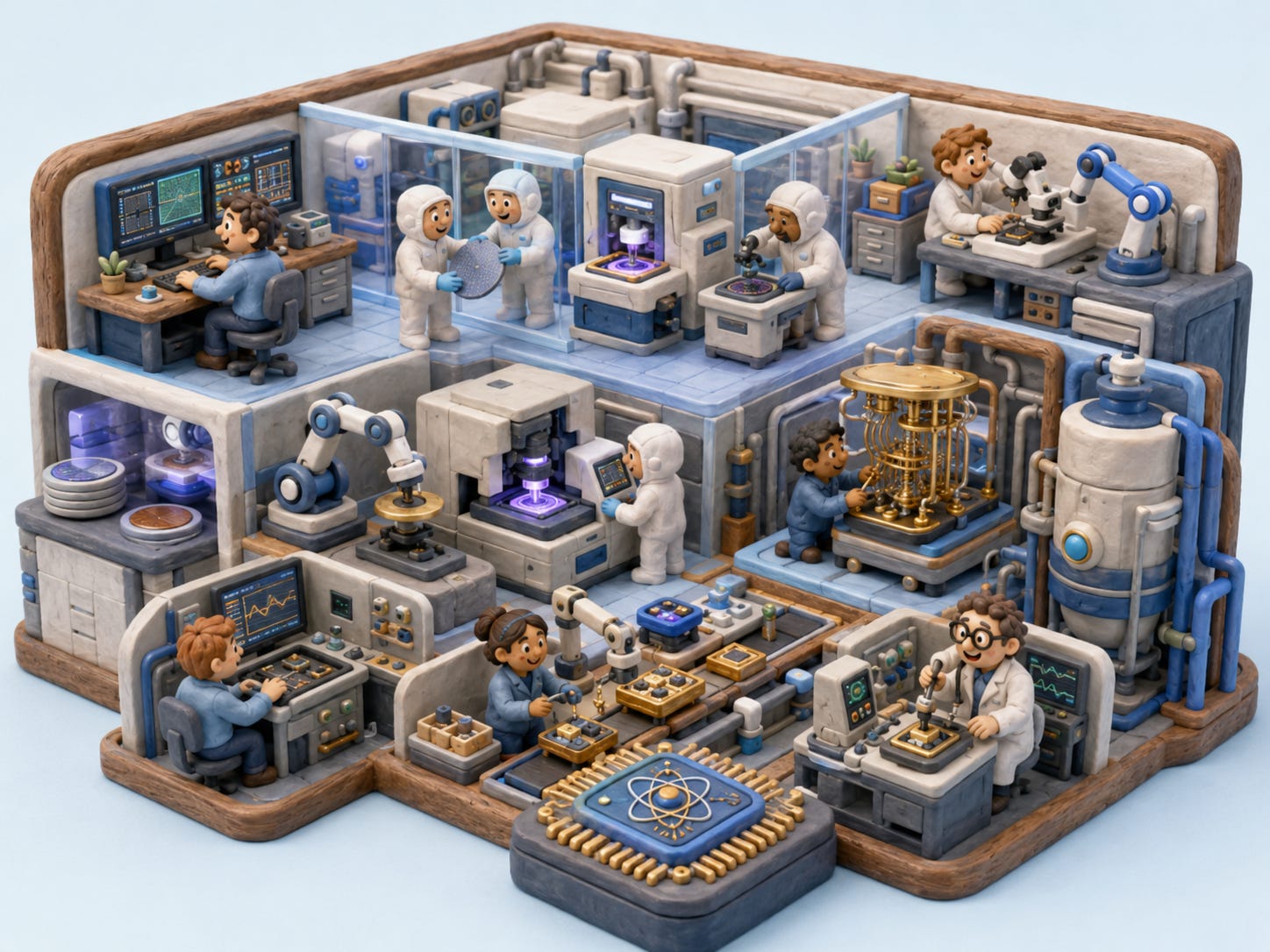
In this edition: Over $14 billion in quantum manufacturing commitments landed in the past few weeks. IBM pledged $10 billion and launched America's first quantum chip foundry. The U.S. government took equity stakes in nine quantum companies through $2 billion in CHIPS Act incentives that fund fabs, not research. France added €1.55 billion for quantum and semiconductor manufacturing one day later. QuantWare, a Dutch QPU manufacturer, closed a $178 million Series B. I trace the pattern: this money is building a quantum component industry, not monolithic machines, and the critical gap it reveals is systems integration. OQC closed Europe's largest private quantum round at £260 million, betting on a vertically integrated model that runs against this grain. Microsoft unveiled Majorana 2, claiming 20-second qubit lifetimes on a fabrication path no one else can use. D-Wave published a gate-model roadmap. I also launch the Quantum Snake Oil Dictionary and announce a new Deep Dive series on how quantum computers are actually built, alongside my forthcoming book Quantum Systems Integration.
The Quantum Factory Buildout: $14 Billion and Counting
The headlines read like a funding arms race: IBM commits $10 billion. Washington distributes $2 billion in CHIPS Act incentives.France adds €1 billion for quantum plus €550 million for semiconductor industrialization (€1.55 billion announced in a single speech), bringing its total quantum commitment to €3.3 billion, with NVIDIA backing Alice & Bob's cat qubit program the same day. QuantWare closes a $178 million Series B backed by Intel Capital and In-Q-Tel. The press release version of this story is about big numbers and national ambition. Look at what the money is actually buying and a different picture emerges.
It is buying factories. Not research grants, not algorithm development, not application pilots. Factories.
IBM’s Anderon is a 300mm quantum wafer foundry in Albany, New York. GlobalFoundries received $375 million to build cryo-CMOS, advanced packaging, and superconducting interconnect manufacturing capabilities. France’s latest tranche is explicitly manufacturing-focused. QuantWare’s entire business model is selling QPU chips as standalone products to customers who integrate them into their own systems.
QPUs, Not Monoliths
Here’s the pattern most coverage misses: none of this money is building complete quantum computers. It is building quantum processing units and the supply chain components around them. QPU wafers. Cryo-CMOS control chips. Interconnects. Packaging. Dilution refrigerators. The industry is componentizing.
This is the classical semiconductor model playing out in quantum. Anderon wants to be the TSMC of quantum: fabricate chips for anyone, not just IBM. QuantWare already operates this way; its Contralto-series processors ship as off-the-shelf QPUs that customers mount in their own cryostats with their own control electronics. The Denver consortium I profiled assembled a working quantum computer from five different vendors’ components in five months, for under $8 million: a Dutch QPU, Dutch control electronics, an American cryostat, Australian calibration software, and a global supply chain partner.
When QPUs become products rather than one-off laboratory artifacts, the bottleneck shifts. Manufacturing is being solved. What is not solved is the integration layer: who takes a QPU from QuantWare, a cryostat from Bluefors, control electronics from Qblox, calibration software from Q-CTRL, and HPC interconnects from NVIDIA, and turns them into a working quantum computer? This is the quantum systems integration problem, and it is the least-funded, least-discussed, and most consequential gap in the quantum stack.
Parsing IBM’s $10 Billion
IBM’s headline number deserves evidence-based scrutiny. The $10 billion is a five-year commitment spanning R&D, capex, manufacturing, ecosystem partnerships, and M&A, capturing spending IBM would have made regardless. For comparison, IBM’s total R&D spending was approximately $7.4 billion in 2025 across all business lines. And $2 billion of the headline is Anderon (including the $1 billion CHIPS Act incentive). Still a very large number. But it lands differently than a $10 billion research investment.
The Anderon foundry itself is the most concrete piece. The shift from 200mm to 300mm wafer processing produces device output 30 times faster, according to IBM Research Director Jay Gambetta. For superconducting quantum companies running small-batch fabrication in university cleanrooms, access to dedicated 300mm production could compress development timelines by years. But the TSMC analogy has limits: Google fabricates its own chips, Quantinuum and IonQ use trapped ions, Microsoft sits on a different fabrication path entirely. Anderon’s near-term customer base is a handful of other superconducting companies, who’ll need to weigh production access against sharing process knowledge with their largest competitor.
Government as Quantum Shareholder
Washington’s $2 billion CHIPS quantum package represents a portfolio bet across modalities: superconducting (IBM, Rigetti), trapped ion (Quantinuum, Infleqtion), neutral atom (Atom Computing), photonic (PsiQuantum), annealing plus gate-model (D-Wave), and silicon spin (Diraq). In exchange, the government takes minority, non-controlling equity stakes in all nine companies. As I noted in my sovereignty analysis, when a government starts building purpose-built quantum fabrication facilities, it is no longer asking whether the technology works. It is preparing to produce it at scale.
Wall Street’s reaction was telling. D-Wave, Rigetti, and Infleqtion each surged over 30% on CHIPS Act day, collectively adding nearly $5 billion in market capitalization on $300 million in proposed awards. D-Wave reported $2.9 million in Q1 2026 revenue.
What Starling Means for the CRQC Path
IBM Quantum Starling targets 200 logical qubits executing 100 million gates by 2029, using qLDPC codes that IBM claims reduce physical qubit overhead by up to 90% compared to surface codes. If delivered, Starling would validate several CRQC Capability Framework dimensions simultaneously: QEC at scale, below-threshold operation, magic state production across modules, and real-time decoding. None of those has been demonstrated at the scale IBM is targeting. Two hundred logical qubits remains far from the amount required for cryptographic attacks on RSA-2048 or ECC-256. But the manufacturing infrastructure now being built is what would produce the hardware if and when the engineering milestones are met. The money arrives before the capability.
OQC’s £260 Million Bet Against the Grain
Oxford Quantum Circuits just closed £260 million ($350 million) in Series C funding, Europe’s largest private quantum round. The British Business Bank committed £100 million; J.P. Morgan acted as placement agent. Total funding now stands at roughly $490 million.
The money is for TITAN, OQC’s planned 2028 system: 200 logical qubits within 2,000 physical lattice sites on a single 100mm wafer, running at 1 MHz clock speed with a target logical error rate of 10⁻⁶. Between TITAN and OQC’s current 32-qubit Toshiko system sits GENESIS, a 16-logical-qubit stepping stone using dual-rail Dimon qubits.
Here’s what makes OQC worth watching in the context of this edition’s manufacturing theme: OQC is doing the opposite of what everyone else is doing. While IBM builds an open foundry, QuantWare sells QPUs as standalone products, and the Denver consortium assembles machines from five vendors’ components, OQC is pursuing a monolithic, vertically integrated architecture. One company, one chip, one wafer, one system.
The bull case: vertical integration lets OQC optimize across the full stack, avoid interface losses between separately manufactured components, and potentially deliver a more coherent system. The bear case: OQC is fabless (its Coaxmon QPUs are manufactured by external partners), which means it gets the supply chain dependency of a component buyer without the flexibility of the open architecture approach. The TITAN roadmap asks investors to believe OQC can go from 32 physical qubits to 200 logical qubits in two years, a jump that would require error correction breakthroughs no one in the industry has demonstrated at scale. IBM is targeting the same 200 logical qubits but gives itself until 2029, has $10 billion behind the effort, and owns its own foundry.
OQC’s investor mix also catches the eye. The round was led by a TMT investment bank, not a deep-tech VC or semiconductor-industry strategic. No Breakthrough Energy, no Intel Capital, no DARPA validation. The British Business Bank’s £100 million carries a sovereign industrial policy signal, but it is government money backing a UK national champion, which is a different kind of due diligence than commercial investors applying.
I will be tracking OQC’s GENESIS milestones closely. If dual-rail Dimon qubits deliver the error rates OQC claims, the TITAN timeline becomes more credible. If GENESIS slips, £260 million starts to look like a very expensive bet on a roadmap that hasn’t earned its next milestone.
Microsoft Majorana 2: 20-Second Qubits, Same Questions
At its Build conference, Microsoft unveiled Majorana 2, its second-generation topological quantum chip. Z-parity lifetimes exceeding 20 seconds, a 1,000x improvement over Majorana 1, achieved by swapping aluminum for lead as the superconducting material. Microsoft accelerated its timeline from 2033 to 2029.
The materials engineering is genuine. Several prominent physicists responded within hours, and their objections are: the Majorana zero mode has never been unambiguously demonstrated. Microsoft’s 2018 Nature paper claiming Majorana signatures was retracted in 2021 after data-processing errors. Majorana 2 reports parity lifetimes and topological gap measurements consistent with a topological qubit, but also potentially consistent with trivially gapped Andreev bound states. What the paper does not show: a logical qubit operation, a two-qubit gate, entanglement between topological qubits, or error correction using topological protection.
For the CRQC timeline: nothing changes. Microsoft’s topological approach still scores at the earliest stages of the CRQC Capability Framework. I will update the CRQC Scorecard when the peer-reviewed paper is available.
What makes Majorana 2 worth pairing with this edition’s manufacturing story: topological qubits require InAs/Pb heterostructures on GaSb substrates, entirely different materials and processes from superconducting transmon qubits. Microsoft cannot use Anderon. It cannot use QuantWare’s QPUs. Its supply chain is entirely bespoke. The $14 billion flowing into superconducting and multi-modality fabs is a bet on the established path. Microsoft’s bet is on its own. If topological qubits work, that isolation could become a moat. If they don’t, Microsoft will have built a manufacturing pipeline for a product category that doesn’t exist.
D-Wave Joins the Gate-Model Race
D-Wave, the company that spent two decades on quantum annealing, published a gate-model roadmap targeting 100 logical qubits by 2032, built on dual-rail superconducting qubits acquired through its $550 million purchase of QCI. D-Wave claims Lambda = 10 for error suppression; independent verification is needed. When the one company that had a principled alternative to gate-model computing decides it needs gate-model capabilities, that tells you where the industry consensus has settled. CRQC implications: none.
The Builder’s Guide: A New Deep Dive and a New Book
Every announcement above raises the same question: what does it actually take to build a quantum computer? Not a press release. Not a roadmap. A physical machine, assembled from real components, that produces useful qubit operations.
I published the most engineering-heavy Deep Dive series on PostQuantum.com to date: from empty lab to first qubit signal across every major modality (superconducting, trapped ion, neutral atom, photonic, silicon spin), plus companion articles on cryogenic infrastructure, control systems, supply chain concentration, and cost and procurement. When IBM launches a foundry, this series explains what it fabricates. When QuantWare ships a QPU, it explains what else you need to make it compute.
My book Quantum Systems Integration is coming in the coming days. It covers the full integration framework from site survey through HPC integration, and makes the case that quantum computing is following the classical computing model: components from specialist manufacturers, assembled by integrators. Applied Quantum is doing this work, helping governments and enterprises assemble quantum computers from best-of-breed components rather than depending on a single vendor’s stack. Sign up at quantumsystemsintegration.com to be notified when the book is available. Get in touch if you need help with quantum compute strategy.
Quantum Flapdoodle: The Snake Oil Dictionary Is Live
In an edition about where quantum money actually goes, a new tool for spotting claims where the money should not.
I launched the Quantum Snake Oil Dictionary on PostQuantum.com: a term-by-term field guide to misleading quantum marketing. Nine fabricated red-flag terms. Seven legitimate physics concepts routinely stripped of their qualifying assumptions by vendors. And a companion guide to the 16 deflection tactics questionable vendors deploy when you ask hard questions.
Two entries worth highlighting. “Quantum Financial System“ is an ADL-classified conspiracy theory exploiting quantum vocabulary to defraud retail investors through advance-fee fraud. “Unhackable quantum encryption“ repackages legitimate QKD science into marketing claims that misrepresent what the technology provides. QKD secures a key exchange channel under specific physical conditions; it does not make your network unhackable.
If you found this edition useful, forward it to a colleague who’s evaluating quantum investments, vendor claims, or national quantum strategies. If I got something wrong, hit reply. I read everything and correct publicly. The full PostQuantum.com resource library is at postquantum.com. Start with the How to Build a Quantum Computer Deep Dive.
— Marin
Appreciate the straight (no BS, no hyerbole) approach!